

The 95% Problem: Why AI Land Data Still Needs a Landman’s Review
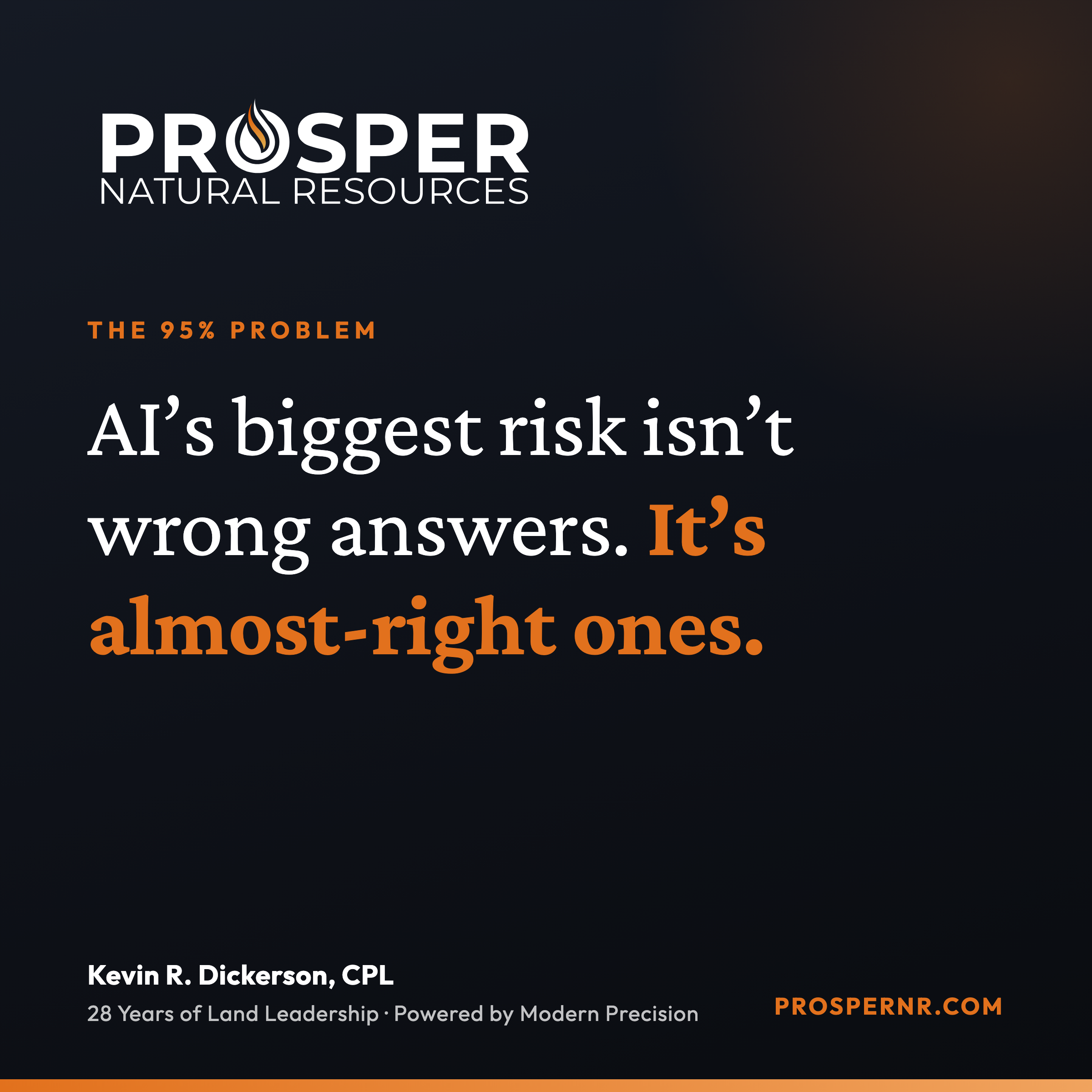
The biggest risk of AI in the land business isn’t that it gets things wrong.
It’s that it gets things almost right, and nobody experienced is checking.
Obviously wrong output is a manageable problem. Somebody notices, it gets fixed, life goes on. Almost-right output is different. It passes review. It goes in the file. It gets relied upon. And then eighteen months later somebody discovers the problem at the worst possible moment.
What “almost right” looks like in land management
A JOA summary that’s 95% accurate sounds great. Until the 5% it missed is the non-consent penalty clause, and you find out during a dispute what you actually agreed to.
A division order deck that’s 95% clean sounds efficient. Until the 5% becomes an interest dispute in year three, with accumulated underpayment and a very unhappy royalty owner who now has an attorney.
A title opinion where 95% of the chain checks out is not a title opinion. The whole value is in the exceptions.
Notice that in each case, the failure isn’t random. AI tends to miss the unusual: the non-standard clause, the odd conveyance, the exception to the pattern. Which is precisely where the money is.
This is not an anti-AI argument
I use AI every single day, across almost everything we do at Prosper Natural Resources. I’m a believer. The efficiency gains are real and I’m not going back.
But I believe in it the way a pilot believes in autopilot: it flies most of the route. You still want somebody in the seat who’s landed in bad weather.
Twenty-eight years in this business taught me where the bad weather is.
What review actually needs to look like
Effective review isn’t spot-checking a random 10% of AI output. It’s targeted at the places where “almost right” is expensive:
Non-standard provisions: anything an attorney clearly touched
Exceptions and carve-outs: where the document departs from the form
Anything with a penalty, forfeiture, or non-consent mechanism
Ownership decimals that will be relied on for payment
Curative items where the AI concluded something was resolved
That’s a Certified Professional Landman’s job. Not because the software is bad, but because knowing where to look is the expertise.
The question worth asking your vendor
If you’re evaluating an AI land data solution, ask who reviews the output and what their credentials are. If the answer is “the model is very accurate,” that’s not an answer.
Want CPL-level review on your land data? Get in touch.
From Courthouse Title Runs to AI: What 28 Years in Land Management Taught Me
I started this career running title in county courthouses. Paper, dust, and a legal pad.
Twenty-eight years later, the AI tools I use every day process in hours what used to take me months in those courthouses.
Here’s what surprised me: the technology didn’t make that experience less valuable. It made it more valuable.
What the courthouse years actually taught
It’s tempting to think of manual title work as pure grunt labor, the thing we’re all glad to be rid of. But those years weren’t just about the work product. They were about building a mental model of how chains of title actually break.
You learn what a suspicious conveyance looks like. You learn which counties have recording practices that create predictable gaps. You learn that a “standard” clause isn’t standard the moment somebody’s attorney got involved in 1987.
None of that is written down anywhere. It’s accumulated exposure.
What automation actually changed
When the volume work is automated, what’s left is exactly the work that takes years to learn:
Structuring the deal
Reading the negotiation
Knowing when a “standard” clause isn’t standard
Deciding which title defect is material
In other words, automation didn’t replace the expertise. It removed everything that was crowding out the expertise.
I spend less time now confirming what a document says and more time deciding what it means. That’s a better use of a Certified Professional Landman, and frankly a better use of a client’s money.
To land professionals worried AI makes them obsolete
It doesn’t. But it does change what you’re being paid for.
If your value proposition is that you can read a lot of documents accurately, that’s genuinely under pressure. If your value proposition is that you know which documents matter and why, that’s more valuable now than it was twenty years ago, because the volume work no longer buries it.
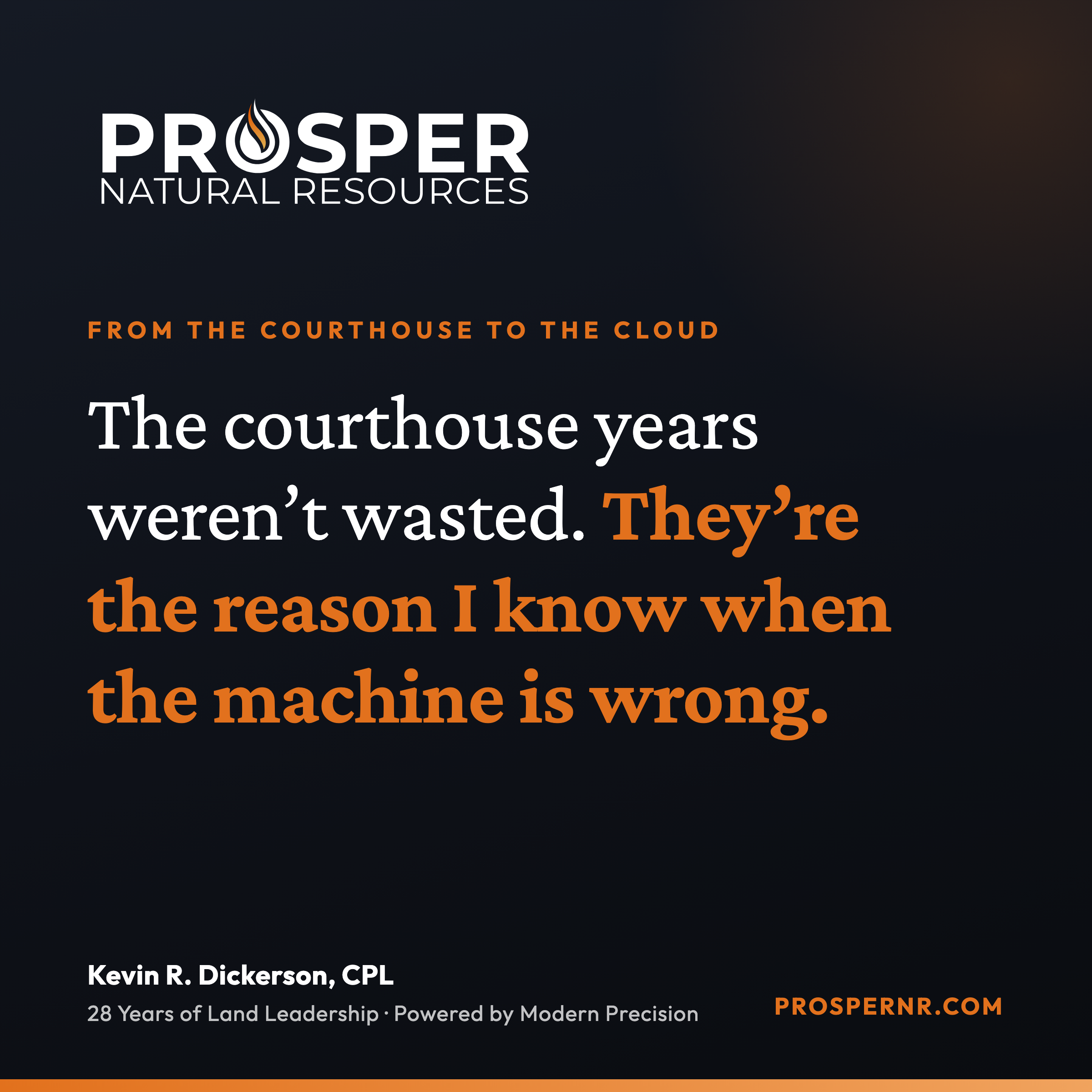
The courthouse years weren’t wasted. They’re the reason I know when the machine is wrong.
Building out your land function? Let’s talk about where experience still has to sit in the process.
What Should a Landman Automate, and What Should They Never Touch?
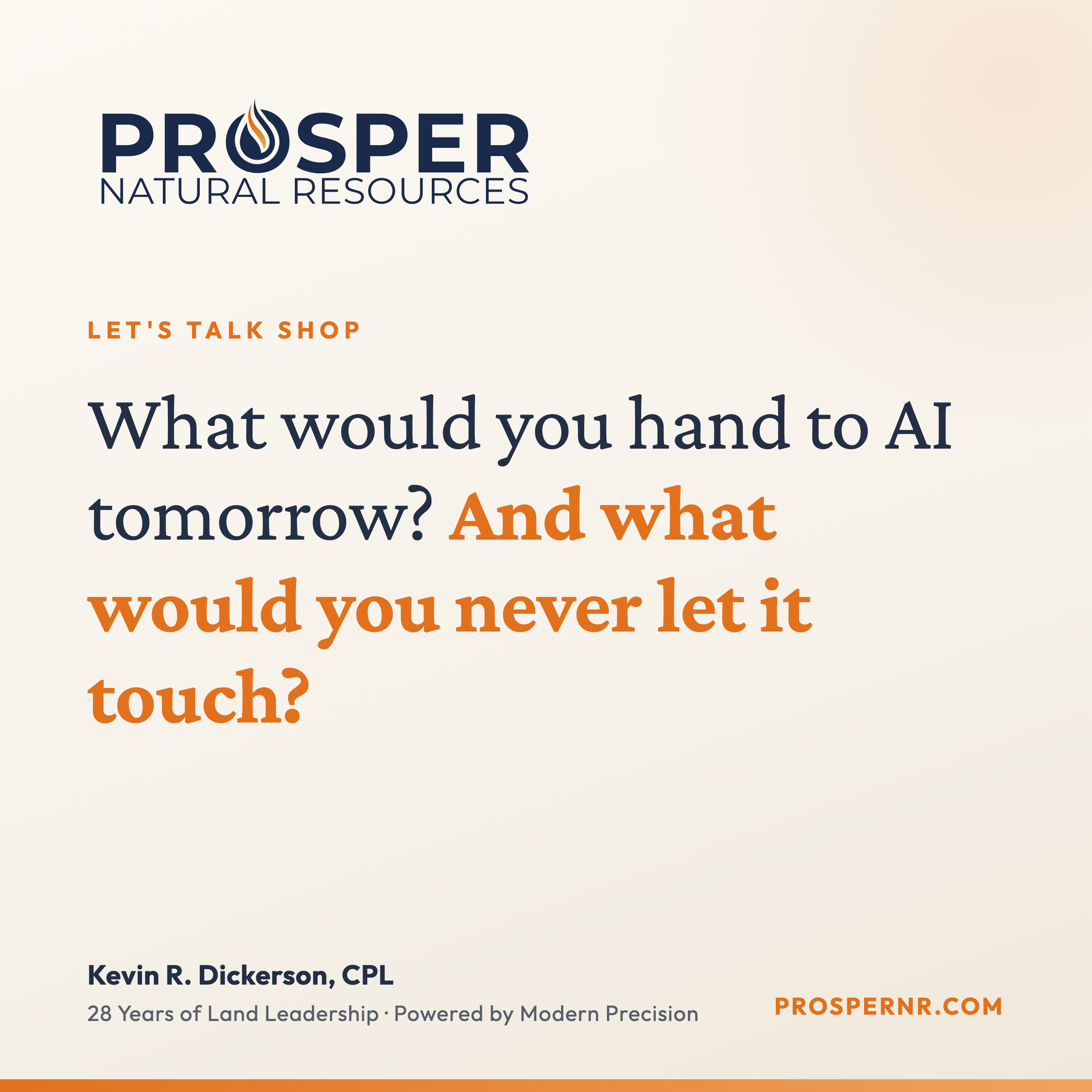
Every land professional I talk to is working through the same question right now: how much of this job can software actually do?
It’s worth answering carefully, because getting it wrong in either direction is expensive. Automate too little and you’re paying people to do work a machine does better. Automate too much and you find out, usually eighteen months later, that nobody was checking.
Here’s my answer.
Hand it over tomorrow: high-volume lease work
Chasing provisions and expirations across a few hundred oil and gas lease files.
This is the clearest case for automation in land management. It’s high-volume, it’s pattern-based, it’s tedious, and human attention degrades over long documents in a way that software’s doesn’t. The AI workflows I’ve built at Prosper Natural Resources do in hours what used to take me weeks in a courthouse basement.
Similar categories that automate well:
Lease provision extraction and obligation tracking
Division order data administration
Ownership data reconciliation
First-pass document review and flagging
Notice the pattern: these are all tasks where the machine surfaces something for a human to act on. That’s the safe shape.
Never let it touch: the negotiation
A JOA. A farm-out. A tough conversation with a mineral owner who’s convinced they’re being shorted.
That’s still a people business. Twenty-eight years of reading the other side of the table doesn’t come in a software update, and I’ve yet to see a model that can tell when the person across from you is bluffing about their alternatives.
Also on this list:
Deal structure and A&D strategy
Deciding which title defect is material and which is noise
Any judgment call your executive team has to defend to a board
The test I use
Ask: if this output were wrong, would anyone notice before it cost money?
If yes, automate it. The error surfaces quickly and cheaply.
If no, that task needs a landman.
What would you automate first in your land department? I’d genuinely like to hear how other land professionals are drawing this line. Reach out.

Land Management for Lean-Staffed Operators: Scaling Without Adding Headcount
How mid-sized operators get executive-level land administration, including A&D due diligence, lease analytics and division orders, without adding headcount.
To the lean-staffed operators out there: you no longer have to choose between big-company land administration and big-company overhead.
Ten years ago, sophisticated land management meant headcount. The majors could afford a full land department: analysts, division order clerks, title staff, a VP to run it. Everyone else made do with a skeleton crew and hoped nothing important slipped.
That math has changed.
What’s actually different now
At Prosper Natural Resources, I’ve spent the last few years building an AI-powered practice around nearly three decades of executive land experience. The structure looks like this:
Accelerated by AI systems I’ve built:
Oil and gas lease analytics and obligation tracking
A&D due diligence and interest verification
Division order preparation and data management
Title and regulatory land services
Running on a plug-and-play platform through our partnership with Firm App:
Owner relations: centralized mineral and royalty owner communication, with 24/7 self-service access to payments and ownership data
Handled by experience, not software:
Negotiations: JOAs, farm-outs, trade agreements
A&D strategy and deal structure
The executive-level judgment calls, made by someone who’s sat in the VP chair
Why this works for mid-sized operators specifically
The economics of a full in-house land department only make sense above a certain asset count. Below that line, you’re either overpaying for capacity you don’t use or understaffed for the work you actually have.
An outsourced, AI-accelerated land function scales with the portfolio instead of with the org chart. You add acreage without adding seats.
The catch, and it’s a real one, is that automation alone doesn’t get you there. AI output that nobody experienced is reviewing is a liability, not an asset. What makes this work is the combination: machines handling volume, a CPL handling judgment.
What this looks like in practice
Every engagement is different, but the common thread is that operators get:
Faster turnaround on lease analysis and due diligence than an internal team of comparable size
CPL-level verification on anything that carries risk
No fixed headcount cost
Weighing that decision for your land function? Send me a note. Happy to compare notes, no pitch required.
AI in Land Management: What to Automate, and What Still Needs a CPL
AI is the best analyst I’ve ever hired. It’s still not the decision-maker.
That distinction matters more than most of the conversation around AI in oil and gas land management admits. The technology is genuinely transformative for certain categories of work, and genuinely dangerous when applied to others.
Here’s how I draw the line at Prosper Natural Resources.
Where AI Earns Its Keep
I’ve built AI into nearly every corner of our land practice. Oil and gas lease analysis and due diligence that used to take weeks now takes days. Chasing provisions, expirations, and obligations across a few hundred lease files is exactly the kind of high-volume, pattern-matching task machines handle well.
Division order and land data administration is accelerated across every engagement. Owner relations is streamlined through our partnership with Firm App, which provides the AI-powered ticketing and self-service platform on that side of the practice.
The efficiency gains are real. I’d put our output against a land department three times our size.
Where Experience Still Makes the Call
Here’s the part I won’t automate: the judgment calls.
After 28 years managing assets from the Permian Basin to the Williston Basin, I know which title defect kills a deal and which one is just noise. That’s not a database lookup. It’s pattern recognition built from having been wrong before and remembering exactly how it went.
AI flags the issue. Experience makes the call your executive team can stand behind.
The same is true for negotiation. A joint operating agreement, a farm-out, a difficult conversation with a mineral owner: that’s a people business, and reading the other side of the table doesn’t come in a software update.
The Model: Machines for the Volume, Gray Hair for the Judgment
Operators asking whether they should be using AI in their land department are asking the wrong question. The right question is which parts.
Automate the volume. Keep a Certified Professional Landman on the judgment. That combination is what lets a lean-staffed operator get big-company land administration without big-company overhead.
Considering that split for your own land function? Get in touch. Happy to compare notes.

Strategic Partnership Announcement
Strategic Partnership Announcement
Prosper Natural Resources and Firm.app Launch First-of-Its-Kind "Plug-and-Play" Land Administration Solution
[Norman, OK / 2026] — Prosper Natural Resources, a premier land management consultancy, is proud to announce a strategic technology partnership with Firm.app, a leader in AI-driven energy administration. This collaboration introduces the industry’s first "Plug-and-Play" contract services solution, specifically designed to modernize land administration and owner relations for lean-staffed energy operators.
Bridging the Gap Between Expertise and Efficiency
As land departments face increasing pressure to manage complex portfolios with fewer resources, the need for scalable, high-tech solutions has never been greater. This partnership combines the executive-level oversight of Kevin R. Dickerson, CPL, with Firm.app’s cutting-edge AI platform to deliver a turnkey service that handles the "heavy lifting" of land administration from day one.
The Integrated Solution Includes:
AI-Powered Owner Relations: A centralized ticketing system that unifies phone, email, and chat, ensuring rapid, professional responses to all owner inquiries.
Secure Owner Self-Service: A digital portal giving royalty and working interest owners 24/7 access to their payments, tax documents, and ownership records.
Automated Contract Administration: Streamlined processing of Division Orders, interest transfers, and leasehold data management, all verified by CPL-level expertise.
A Quote from Kevin R. Dickerson, CPL, Founder & CEO:
"For decades, smaller operators have had to choose between manual, slow-moving land processes or expensive, enterprise-level overhead. Our partnership with Firm.app changes that. We are offering a sophisticated, tech-forward administration solution that operators can 'plug' into their existing workflow immediately. We manage the technology and the owner relations; they focus on growing their assets."
About Prosper Natural Resources
Prosper Natural Resources provides executive-level land consulting and strategic solutions for the energy industry. Specializing in A&D due diligence, lease analytics, and CPL-led administration, Prosper serves operators across the Mid-Continent, Permian, Rockies, and Gulf Coast regions.